
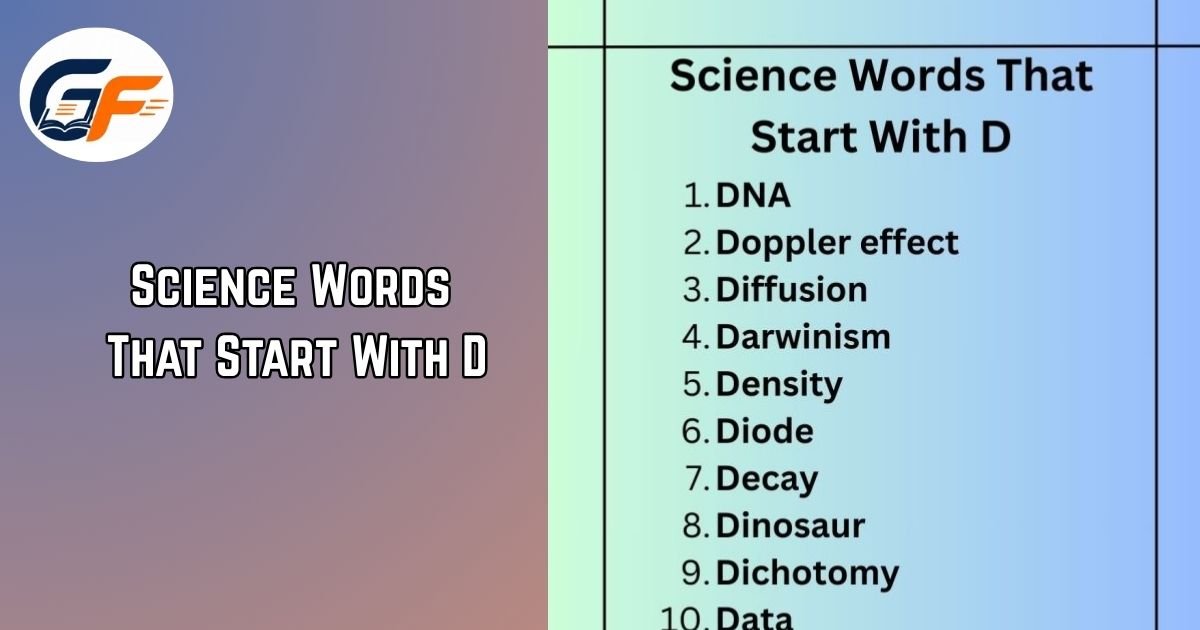
Science Words That Start With D: A Complete Guide
Science has many interesting terms that begin with the letter D. From diffusion and density to DNA and decomposition, these words are used in biology, chemistry, physics, earth science, and other scientific fields. Learning science words that start with D can help students improve their scientific vocabulary and understand important concepts more easily. In this article, we will explore useful and common scientific terms beginning with D, along with simple explanations and examples.
What Are Science Words That Start With D?
Science words that start with D are scientific terms, concepts, processes, objects, and measurements that begin with the letter D. They can come from different branches of science and may describe physical properties, biological processes, chemical reactions, or natural phenomena.
Some familiar examples include density, DNA, digestion, diffusion, diameter, and decomposition. Understanding these terms is useful for students because scientific vocabulary often appears in textbooks, experiments, exams, research papers, and classroom discussions.
Density
Density is a scientific measurement that describes how much mass is contained within a certain volume of a substance. It is commonly calculated by dividing mass by volume. Objects with greater density have more matter packed into a given space.
Density is important in physics, chemistry, geology, and materials science. For example, water has a lower density than many metals, which is why certain metals sink in water. Scientists use density to identify substances and study how materials behave under different conditions.
Diffusion
Diffusion is the movement of particles from an area where they are more concentrated to an area where they are less concentrated. This process happens naturally because particles are constantly moving.
Diffusion is especially important in biology because it helps substances such as oxygen and carbon dioxide move across cell membranes. It can also be observed when perfume spreads throughout a room. The process continues until particles become more evenly distributed throughout the available space.
DNA

DNA stands for deoxyribonucleic acid and is one of the most important molecules in living organisms. It contains genetic information that provides instructions for the development, functioning, growth, and reproduction of organisms.
DNA is found mainly inside cells and is organized into structures called chromosomes. Its famous double-helix shape allows genetic information to be stored efficiently. Scientists study DNA in genetics, medicine, biotechnology, evolution, and forensic science. DNA is also passed from parents to their offspring.
Digestion
Digestion is the biological process through which food is broken down into smaller substances that the body can absorb and use. It begins in the mouth when food is chewed and mixed with saliva.
The digestive system then continues breaking food down in the stomach and intestines. Nutrients are absorbed mainly through the small intestine. Digestion provides the body with energy and materials needed for growth, repair, and normal functioning. It involves mechanical and chemical processes working together.
Decomposition
Decomposition is the natural process in which dead plants, animals, and other organic materials are broken down into simpler substances. Bacteria, fungi, insects, and other decomposers play important roles in this process. Decomposition returns nutrients to the environment and helps maintain healthy ecosystems.
Leaves, fallen branches, and dead animals eventually break down and contribute nutrients to soil. Without decomposition, organic waste would accumulate, and important nutrients would not be efficiently recycled through natural ecosystems.
Diameter
Diameter is a measurement used in geometry and science to describe the distance across a circular object through its center. It is twice the length of the radius. Scientists use diameter when measuring planets, cells, particles, tubes, containers, and many other circular structures.
For example, the diameter of a circle can help researchers calculate its circumference and area. Accurate measurements of diameter are important in engineering, astronomy, biology, physics, and laboratory experiments.
Decay
Decay refers to the gradual breakdown or deterioration of materials. In biology, decay commonly describes the decomposition of dead organic matter by microorganisms and other decomposers. In physics, radioactive decay describes the process in which an unstable atomic nucleus changes into another state while releasing radiation.
Therefore, the meaning of decay depends on the scientific field. Biological decay is important for nutrient recycling, while radioactive decay has applications in medicine, archaeology, energy production, and nuclear science.
Decibel
A decibel is a unit used to express the relative intensity or level of a sound. It is commonly abbreviated as dB. Sound levels can range from very quiet sounds to extremely loud noises. Scientists and engineers use decibels when studying acoustics, hearing, communication systems, and environmental noise. Because the decibel scale is logarithmic, an increase in decibel level does not represent a simple linear increase in sound intensity. This makes decibels useful for describing a wide range of sound levels.
Dehydration

Dehydration occurs when an organism loses more water than it takes in. Water is essential for many biological processes, including temperature regulation, transportation of substances, and chemical reactions inside cells.
Dehydration can occur because of sweating, vomiting, diarrhea, insufficient water intake, or excessive fluid loss. In scientific studies, dehydration is examined in biology, medicine, physiology, and environmental science. Maintaining proper water balance is important for cells and tissues to function normally.
Development
Development describes the process through which an organism changes and becomes more mature over time. In biology, development can include changes from a fertilized egg into an embryo, fetus, juvenile, and adult organism.
Scientists study development to understand how cells divide, specialize, and form tissues and organs. Developmental biology is an important scientific field that investigates these processes. Environmental conditions, genes, hormones, and nutrition can all influence development in living organisms.
Diatomic
Diatomic describes a molecule that contains two atoms. The two atoms may be identical or different. For example, oxygen normally exists as O₂, which contains two oxygen atoms, making it a diatomic molecule.
Hydrogen and nitrogen also commonly exist as diatomic molecules. The term is frequently used in chemistry to describe molecular structures. Understanding diatomic molecules helps students learn about chemical bonding, molecular formulas, gases, and the behavior of elements under different conditions.
Digestion Enzymes
Digestive enzymes are proteins that help break food into smaller molecules that the body can absorb. Different enzymes act on different types of nutrients. For example, amylase helps break down carbohydrates, while proteases break down proteins and lipases help digest fats. These enzymes work in different parts of the digestive system, including the mouth, stomach, and small intestine. Their activity is essential for obtaining nutrients from food and supporting the body’s energy and growth requirements.
Distillation
Distillation is a separation technique used to separate substances based on differences in their boiling points. During distillation, a mixture is heated so that one component vaporizes more easily than another. The vapor is then cooled and condensed back into a liquid. This method is widely used in chemistry laboratories and industrial processes. Distillation can be used to purify liquids, produce distilled water, and separate components of certain mixtures. It is an important technique in chemical science.
Displacement
Displacement is a scientific concept with different meanings depending on the field. In physics, displacement describes the change in an object’s position from its starting point to its final position and includes direction. In chemistry, a displacement reaction occurs when one element replaces another element in a compound. For example, a more reactive metal can replace a less reactive metal in certain chemical reactions. Understanding displacement helps students distinguish movement from distance and recognize chemical reaction patterns.
Diffraction
Diffraction is the bending or spreading of waves when they pass around obstacles or through narrow openings. It can occur with light, sound, water waves, and other types of waves. The amount of diffraction depends partly on the relationship between the wavelength and the size of the opening or obstacle. Scientists use diffraction to investigate wave behavior and the structure of materials. X-ray diffraction, for example, is an important technique used to study the arrangement of atoms in crystals.
Doppler Effect
The Doppler effect describes the change in the observed frequency of a wave caused by relative motion between the source and the observer. A common example is the changing pitch of a vehicle’s siren as it approaches and then moves away.
The effect applies to sound waves and electromagnetic waves, including light. Astronomers use the Doppler effect to study the movement of stars and galaxies. It is also useful in radar technology, medical imaging, and other scientific applications.
Dark Matter
Dark matter is a form of matter that scientists believe exists because of its gravitational effects on visible matter and cosmic structures. It does not appear to emit, absorb, or reflect light in the same way as ordinary matter, making it difficult to observe directly.
Researchers study its effects on galaxies, galaxy clusters, and the large-scale structure of the universe. Although its exact nature remains unknown, dark matter is an important topic in modern astronomy and cosmology.
Dark Energy
Dark energy is a term used in cosmology to describe the unknown component associated with the accelerated expansion of the universe. Observations show that the universe’s expansion has been accelerating, and scientists use dark energy as a framework for explaining this observation.
Its nature is still not fully understood. Dark energy is different from dark matter, although both are major topics in modern cosmology. Researchers continue studying the universe’s expansion to better understand this mysterious phenomenon.
Dermis
The dermis is a layer of skin located beneath the outer epidermis. It contains structures such as blood vessels, nerves, hair follicles, sweat glands, and connective tissue. The dermis provides strength and flexibility to the skin and helps regulate temperature through blood flow and sweating. In biology and anatomy, studying the dermis helps explain how the skin protects the body and senses the environment. It works together with the epidermis and underlying tissues to maintain healthy skin.
Dopamine
Dopamine is a chemical messenger called a neurotransmitter that plays several important roles in the nervous system. It is involved in movement, motivation, learning, attention, and reward-related processes. Dopamine is produced by certain nerve cells and transmits signals between neurons.
Scientists study dopamine in neuroscience, psychology, and medicine because changes in dopamine signaling are associated with several neurological and behavioral conditions. Its functions are complex and depend on where and how it acts in the nervous system.
DNA Replication
DNA replication is the biological process through which a cell makes a copy of its DNA before cell division. The DNA double helix separates, and each original strand serves as a template for creating a new complementary strand.
Enzymes help control and complete this process. Accurate DNA replication is essential because daughter cells need genetic information to function properly. Scientists study DNA replication to understand genetics, cell biology, inheritance, development, and certain diseases.
Science Words That Start With D in Biology
Biology contains many scientific words beginning with D. Some important examples include DNA, digestion, diffusion, development, dermis, dopamine, decomposition, and digestive enzymes. These terms describe molecules, body processes, cellular activities, biological structures, and ecological processes.
Learning these words can help students understand how living organisms grow, reproduce, obtain nutrients, communicate internally, and interact with their environment. Many of these terms are commonly introduced in school biology and become more detailed in advanced scientific studies.
Read More: Other Ways to Say Thank You for Your Concern: 25+ Polite Alternatives
Science Words That Start With D in Chemistry
Chemistry also includes many useful D words, including density, distillation, diatomic, decomposition, displacement, diffusion, and decay. These terms can describe physical properties, molecular structures, separation methods, chemical reactions, and radioactive processes.
Understanding them helps students recognize important patterns in chemical science. For example, density can help identify a substance, while distillation can separate components of a mixture. Diatomic describes certain molecular structures, and displacement describes a particular type of chemical reaction.
Science Words That Start With D in Physics
Physics uses several important terms beginning with D. Examples include displacement, diffraction, decibel, density, and Doppler effect. These words describe motion, waves, sound, measurements, and properties of matter.
Displacement helps explain changes in position, while diffraction demonstrates wave behavior. Decibels are commonly used to describe sound levels, and the Doppler effect explains changes in observed frequency caused by motion. Learning these terms gives students a stronger foundation for understanding physical laws and scientific experiments.
Science Words That Start With D in Astronomy
Astronomy includes fascinating D words such as dark matter, dark energy, dwarf planet, diameter, and Doppler effect. Scientists use these terms to describe objects, measurements, and phenomena associated with space. Dark matter and dark energy are especially important areas of modern cosmology.
A dwarf planet is a type of celestial body, while diameter can be used to measure astronomical objects. The Doppler effect helps astronomers study the motion of stars, galaxies, and other objects across the universe.
Final Thoughts
There are many useful science words that start with D, and they cover almost every major branch of science. Terms such as density, DNA, diffusion, digestion, decomposition, displacement, diffraction, and dark matter introduce students to important scientific ideas.
Learning these words with simple definitions makes complex subjects easier to understand and remember. Whether you are preparing for an exam, writing a science assignment, or simply expanding your vocabulary, studying scientific terms alphabetically can be an effective way to build your knowledge.
FAQS
What Are Some Science Words That Start With D?
Some common science words that start with D include density, diffusion, DNA, digestion, decomposition, displacement, diffraction, distillation, decibel, and Doppler effect.
What Is A Science Word That Starts With D In Biology?
DNA is an important science word that starts with D in biology. It stores genetic information and helps control the growth, development, and functioning of living organisms.
What Is A Science Word That Starts With D In Physics?
Displacement is a common physics term that starts with D. It describes the change in an object’s position from its starting point to its final position, including direction.